Showing posts with label binding designer. Show all posts

Friday, March 22, 2019

Marion Peabody update!

Remember our blog post about Marion Peabody, the binding designer, whom we posted about way back in 2015? If not, go check it out! You can even see the photograph of her that we found in passport records.

Anyway, we have an update thanks to the sleuthing of Linda Obora! I was sitting at my desk in November of 2018 when a manila envelope was handed to me. Intrigued, I immediately opened it and pulled out the enclosed papers and letter. The letter was from Linda Obora, a genealogy researcher, and she had traced information about Marion and found her death date. Not only did she provide this information, but also was able to send us a copy of her death certificate and (drum roll, please) her WILL! How awesome is that? Thank you so much, Linda! 

Luckily, her research helped answer some of the unknowns from the previous post. We had found a tombstone that looked very much like it was Marion's, but we couldn't find that one missing link that definitively said that this was indeed "our" Marion. These documents linked everything together. So without delay, I want to share with you what Linda found. 

Marion Louise Peabody died January 9, 1937 at 6:15 pm in her home at Via Mario del Fiori, 16, Rome, Italy. 

There's just something about being able to see the same cobble stone streets she would have walked, probably the same door that she would have opened day in and day out, the same scenery she would have walked past on the way to pick up some things at the market--it makes her life more "real". Thankfully, Google Maps gives us this ability to see these things without physically being there. Check it out!


She died from cancer of the liver which was certified by her physician, Dr. Giulio Brocchieri. She was cremated and then buried in the Protestant Cemetery in Testaccio, Rome (the resting place of John Keats, Percy Shelley). The death certificate even spells out the exact plot in the cemetery where she was buried

Here is her tombstone, courtesy of Find a Grave.


It reads:

Qui le ceneri
lassu l'anima angelica 
di 
Marion L. Peabody
di Boston, Mass., U.S.A. 
Diletta dal signore
nella bontae nella sofferenza
le sia premio
la vita eterna
Roma 9, Gennaio 1937

(transcription from Find a Grave; "bontae" should read "bonta e")

Her brother in law, Lionel Simeon Marks (husband of Josephine Peabody, the famous author), was notified of her death by a telegraph sent to Harvard University, where he was employed, on January 9, 1937 and January 10, 1937. Josephine had died in 1922, so it's telling that her brother-in-law was the one notified. Marion's passport was destroyed on January 11, 1937, a scant two days after she passed. J. Wesley Jones, the vice consul of the United States of America, signed off on her death certificate which was officially filed February 5, 1937.  Her effects were left in the care of a Mr. Luigi Trombetti, the executor of the will. 

It never ceases to amaze me that you can find so much information on a death certificate. 

But now I was curious about Mr. Luigi Trombetti. Who was he--a friend? Simply her lawyer? My attention turned to the translated three page copy of the will that Linda included with the death certificate and letter. You can glean so much information from a will. You find out who was most important or closest to the deceased--well, important enough to warrant leaving them something at any rate. You can peer into their personal lives a little more and find out what things were dear enough to them to want the items to go to someone instead of just being disposed of.

Remember, Marion never married and was a self-sufficient woman who was living in Italy in 1937. Why is that important? Italy was living under the rule of Benito Mussolini. The Rome-Berlin Axis was established in 1936, but Italy had been living under a fascist government long before that. What was that like for her? 

Anyway, back to the will. 

Marion made her will on December 31, 1936, which, as the document points out, is the 15th year of the Fascist Era, at her home on the second floor of number 16, Via Mario del Fiori. Five people, in addition to Marion, were present to serve as witnesses while the will was created:
-Igino Clementi, an Italian notary; 
-John Wesley Jones, who we've already established was the Vice Consul of the United States of America and signed her death certificate; 
-Graham Erskine, an American architect;
-Giovanni Bizzarri, an Italian clerk;
-Pasquale Blasi, an Italian clerk.

The will identifies Marion as "Miss Marion Louise Peabody, daughter of the late Carlo". We learned in the first blog post that she was, in fact, the daughter of Charles (thus Carlo) K. Peabody who died in 1884 when Marion was 15. The will states that she's "ill in bed", so we know the cancer was debilitating at this point, and that Marion died just over a week later. 

The will starts with her niece Alison Peabody Marks, daughter of her sister Josephine Peabody Marks and Lionel Marks. Marion left her several rings (which were thoroughly described), a heart studded with diamonds, silver spoons, and a color picture of Josephine. 

Lionel Peabody Marks, her nephew, was left four decanters with a stand which belonged to her great, great grandmother 

Miss Dora Ohlfsen received two furs and 5000 lire. Say what?! Dora Ohlfsen-Bagge was a fascinating character who was a pianist, sculptor, painter, medallist, and had a brief stint (that we know of) as a spy. A spy, y'all! She and her lifelong companion met an untimely death in 1948 when they were found in their gas filled studio. Police ruled it accidental deaths, but some suspect it was a suicide pact.

Baroness Hélène de Kuegelgen, the companion of Dora Ohlfsen-Bagge and the individual who died with her, was left 5000 lire. 

Marion left Countess Frances du Besse two writing desks.

Mrs. Lia Trombetti Lardel received  a table from the drawing room and an ornate piece of furniture from the hallway.

The Reverend of the American church in Rome, Samuel Tyler, was left Marion's copies of books written by her sister, Josephine.  

The owner of the "Felix" library, Mr. Michele _________ was left the rest of her book collection. 

Mr. Alfredo Cifani was left a writing desk, his choice of chest of drawers or writing desk, and a bureau with the American coat of arms on it. 

Marion remembered her maids in her will as well. To Firmina Ferrari, "Irma" she left all of the kitchen contents including the furniture and utensils, all the contents of the entrance hall, the wardrobe in her bedroom, half of the table service, and half of her clothes and underclothes, though she did specify that Irma couldn't have the silk underclothes. She additionally left her 800 lire. To her other maid, Elvira Ruggieri, she left the other half of her clothes and underclothes (specifying again to not touch the silk) and 800 lire. 

Then, finally, we discover a little bit more about Mr. Luigi Trombetti. Marion left twenty-five lire apiece to Maria Letizia and Maria Immacoleta Trombetti, daughters of Avvocato Luigi Trombetti. So he definitely was a lawyer, but Marion goes on to give hints to their relationship later on in the paragraph saying, "as a token of gratitude for the brotherly and disinterested assistance their father has given me during the last seven years and of the esteem and friendship which I have felt and always shall feel for him." So in answer to my earlier questions, we now know he was both a lawyer and a friend. 

She closed her will with "I remember with affection all my relatives and friends." 

Marion was truly an interesting and fascinating character. She kept company with countesses, baronesses, painters, sculptures, lawyers, and most interestingly to me, a spy. We know her best here at Jackson Library as an accomplished binding designer and didn't want to end this post without a look at some of her work. 

Thanks again to Linda Obera, who did the leg work which offered us a glimpse into Marion Peabody's personal life. I love the fact that we can connect with people we otherwise wouldn't have through this blog. 


Paris and the social revolution : a study of the revolutionary elements in the various classes of Parisian society

Published by Small, Maynard & Company in 1905.


Caleb Trench

Published by Little, Brown, and Company in 1910.


Little Brother o' Dreams 

Published by Houghton, Mifflin Co. in 1910.


Appropriately, we'll end this post with a binding she created for her beloved sister, Josephine Preston Peabody's, book The Wayfarerers.  Published by Copeland and Day, 1898.


Monday, November 23, 2015

Marion Louise Peabody

I always get excited when I discover something new--well, new to me anyway. I was looking around for information on Marion L. Peabody a few months back. We have several books designed by her in our collection, which you can view here. She was a very talented artist who knew how to provoke a response from her art work. I think my personal favorite of her designs appeared on The up grade by Wilder Goodwin (Toronto: Musson Book Company, 1910). The art nouveau cover design was used on the original 1910 Little, Brown and Company edition also.


I was looking for information on Marion Peabody because I was trying to complete her authority record while cataloging a book that had one of her designs. An authority record is set up by library catalogers to establish a standardized form of name that is used for all works by an author or other creator (in this case an artist). We do this so someone searching for a particular person does not have to search all the possible names that she might have used, but can find all her works under the standardized form.(1) The authorized form of her name currently is Peabody, Marion L., 1869-. I was looking around for her death date to add to this authorized form of her name. One of my go to places to find out dates for people is FamilySearch.org. I cannot recommend this site enough. It's free, easy to use, and mostly correct. I would still verify some of the information because part of this information is entered by people like you and me off the street, but when you have scanned documents (like in the case I'm about to discuss), it's hard to dispute the accuracy. 

When I was looking for her death date, I came across her passport application from 1921. You can imagine my excitement if you know anything about passport applications from the 1920s! This document is detailed AND it has a photograph of the artist herself. Nothing makes binding designers more real to me than when I see a photograph of them, or a handwritten letter or something along those lines. 

Looking at her passport application(2) I can verify that she was born in Boston, Massachusetts on April 19, 1869. Her father (who was not living at the time of the passport application) was named Charles K. Peabody and was born in Peabody, Massachusetts. Marion had been living in Italy from April 1912 until October 1920. By the time the passport application was filled out in 1921 she was living at 192 Brattle Street (which is still standing) in Cambridge, Massachusetts. She last got a passport from the U.S. Embassy in Rome on July 31, 1920 which was surrendered and cancelled. She was attempting to return to Italy for "family business" and to "study," and she wanted to set sail on a ship named the Critic on May 12, 1921.

I love how descriptive (or non-descriptive) these passport applications were. In addition to a photograph you were supposed to have a written description. Marion Peabody was listed as:

Age: 52 years
Stature: 5 feet 5.5 inches
Forehead: high
Eyes: Brown
Nose: Straight
Mouth: Medium
Chin: Prominent
Hair: Reddish-brown
Complexion: Fair
Face: Oval
Distinguishing marks: none listed. 

This is the photograph that appeared in the application (thanks to the FamilySearch site for making all this information available):


This is not how I imagined that Marion Peabody looked, but then again I'm not quite sure what I had envisioned. I can almost picture her leaning over a table creating the above binding design.

Once you start researching, you never know what you will dig up. Again, I say, thank goodness for technology and digitization efforts. Without people taking the time to make this information available online, I would have never been able to find this image or know about her living in Italy for so long without a lot of research in print resources.

I still haven't found her death date, but I haven't given up. It will take a little more digging and possibly some time for someone to digitize something that will point me to this date. In the meantime, I'll be content with finding cool clues along the way about Marion L. Peabody and the person she was. 


1. If you're interested in this subject, the Library of Congress has prepared a booklet describing the data format catalogers use and the kinds of records we create. You can find it at: http://www.loc.gov/marc/uma/pt1-7.html
2. "United States Passport Applications, 1795-1925," database with images, FamilySearch(https://familysearch.org/ark:/61903/1:1:QV5B-984T : accessed 18 November 2015), Marion L Peabody, 1921; citing Passport Application, Massachusetts, United States, source certificate #17243, Passport Applications, January 2, 1906 - March 31, 1925, 1561, NARA microfilm publications M1490 and M1372 (Washington D.C.: National Archives and Records Administration, n.d.); FHL microfilm 1,666,802.


Monday, April 20, 2015

Matrimony and Monograms


When we catalog a book for the Charles M. Adams American Trade Bindings Collection--or any other collection when we want to feature the cover--we have two main challenges:  a fair representation of the binding design, endpapers, etc. through our description, and trying to determine who designed the cover.  Sometimes the latter is easy (when we know the signature/monogram or the designer is identified in the book or from a reference source), sometimes it is difficult, and, most often, it is impossible.  Though I don’t have exact numbers on this, out of the approximately two hundred plus signatures and monograms we know about, probably less than half have been identified, and far more bindings are unsigned than signed.  So it’s doubly rewarding when we encounter a puzzle that is not too difficult to solve (reward 1), and also gives a small glimpse into the life of an artist (reward 2).  Such was an identification problem I faced some time ago. 


The book was an attractive title by Laura E. Richards , one of six children of Julia Ward Howe and Samuel Gridley Howe.  She was the author of around 90 books which include Captain January and many other children’s books, biographies (including a Pulitzer Prize-winning biography of Julia Ward Howe), and others.  Its title was The Silver Crown: Another Book of Fables (Little, Brown, and Co., 1906), and among the tree roots at the foot of the cover was a monogram.


The monogram consists of a large “S”, a “W” within the lower counter of the S, and a vertical line through the upper counter of the S and possibly descending to the bottom curve and filling the apex of the W, although this is hard to see without magnification.  When enlarged the vertical line appears to meet the apex of the W and follow the left stroke down.   In addition, the W seems to be tipped towards the right with the left vertex raised slightly above the curve of the S.  So we have a large S, a smaller W, and possibly an I, or a J, or even a T with a rounded top.  I was not familiar with any of these particular combinations.  

The question of the letters in the monogram was quickly answered by the decorated title page which was clearly signed with a vertical JWS.  


But looking further into the book yielded an unexpected bounty:  the book contains 45 fables, each one beginning with a decorative initial.  Of the 45 initials, 30 are monogrammed, plus the additional title page and cover monograms.

What was unusual was that nearly all of the monograms were variations of JWS in different configurations, some with periods, some lacking a letter or two, some in frames, most simple letters but a few overlapping, as with the cover monogram.  The ornamentation varies for all of the letters, some reflecting the fable.  Here are several of the signed initials—it should be obvious which one begins the fable called “The Serpent”! And see if you can spot the one which begins “The Tangled Skein.”         


To really get the feel of how this appears, here are all 30 monograms (not in page number order).


 Of course, cover designers, illustrators, and decorators are not bound to any one form of signature or monogram (although some, such as Margaret Armstrong, used a distinctive monogram from the beginning and kept it throughout their careers).  A case in point is the DecorativeDesigners, whose well known “DD” monogram with the second “D” reversed showed many variations during their 30 year existence, from the Ds barely touching to fully interlocked, and represented in any number of fonts.  Other designers who used a variety of monograms include Theodore Brown Hapgood, Amy Sacker (gathered by our own Mark Schumacher at his Amy Sacker website under Sacker monograms), and F. Berkeley Smith who variously signed bindings S, BS and FBS, with or without a number of different frames, causing all manner of confusion between his covers and those of other designers with similar initials.

Still, 32 variations in one book seems just a little excessive! 

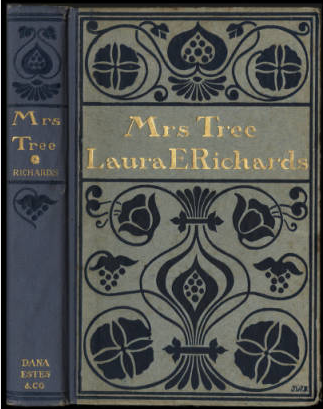
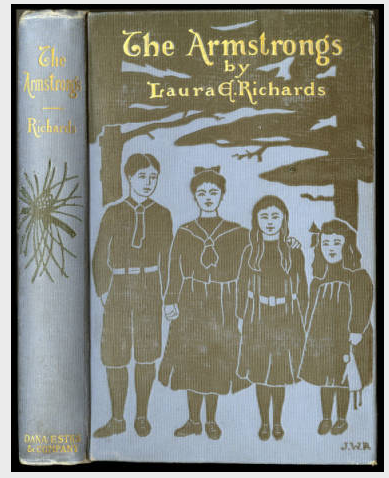
Turning to the identity of the designer/decorator, I knew that Julia Ward Richards, Laura’s daughter, had done binding designs and illustrations for several of her mother’s books, five of which are pictured here.


 ... with their respective monograms.


The monograms looked very similar to those in The Silver Crown except for the final letter—the arrangement, the spotty use of periods, even the style of some of the covers were similar to certain initials in The Silver Crown.  You've no doubt guessed by now what I found when I checked the autobiography of Laura Richards.  In the final chapter, “Milestones,” she says: “In 1905 came the first milestone with an orange blossom laid on it. Julia Ward, my mother’s namesake, married Carleton Anderson Shaw.”  Our mystery designer was indeed Julia Ward Richards, who was known after Dec. 27, 1905, when she was married at Gardiner, Maine, variously as Julia Ward Shaw or Julia Ward Richards Shaw. In 1910 Nathan Haskell Dole wrote of her: “Another daughter, Julia Ward Richards, now Mrs. Carleton Shaw, has had similar success with her pencil.  She has made a specialty of designing book-covers, and in this way her work has been pleasantly associated with that of her mother.” 

I enjoy speculating about just when Julia prepared the initials and cover for her mother’s book.  She was married on December 27th and her mother’s book was listed as “published today” in the October 13, 1906 Publisher’s Weekly, and was then listed in the “Weekly Record of New Publications” in the October 20th issue.  Did Julia work on the new monograms after her marriage, in the ten months between that event and the publication of the book?  Or did she perhaps spend some time before the end of December in designing the initials and working out how she would sign them.  To me, the monograms seem to be more than just fitting a space in the initials.  Whether real or not, there is a feeling of trying things out—varying the letter shapes, seeing what looks good and where--about them.   This is particularly true of the monograms with overlapping letters.  Most of these include the W in the upper counter of the S and do not seem fully worked out.  Throughout, there is a playful feeling of experimentation with that new letter S.  Only the cover monogram looks “finished”--or close to it.  Though her gravestone reads “Julia Ward Richards” the Richards’ “R” is seen nowhere in this book. 

And there we will leave it.  I have not seen any book covers or illustrations in books by Julia Ward Shaw after “The Silver Crown” and if they exist I certainly don’t know if any are signed (although the cover of Laura Richards' 1907 book Grandmother certainly resembles Julia's work).  Nathan Dole’s 1910 piece on Julia Ward Howe quoted above does not make it clear if he is speaking about Julia in the present or in the past.  If any turn up I’ll update this post; but as far as I know, the cover monogram on The Silver Crown is the last by Julia Ward Shaw.  And it’s a good one.

The Silver Crown might be unique.  Though I've seen designers use a number of signatures and monograms over time, I've never seen one so painstakingly—or playfully--working out a monogram in a single place.  Certainly not in such a public one!

Julia Ward Richards Shaw


Laura Elizabeth Richards


Julia Ward Richards Shaw was the 4th of Laura Elizabeth Howe’s and Henry Richards’ seven children.  She was born in Gardiner, Maine on August 30, 1878, and died in Concord, Massachesetts on June 18, 1977 at the age of 98.  She was buried at Groton, Massachusetts.  She married Carleton Anderson Shaw (born Lexington, Massachusetts, May 9, 1873, died Groton, Massachusetts, February 4, 1937) in Gardiner, Maine on December 27, 1905.  Carleton taught at the Lawrence Academy, Groton, Massachusetts, for a year, then established the Red House School in Groton where he was headmaster until his retirement in 1932.  The Shaws had four children, Henry (born Nov. 17, 1906), Elizabeth (born Oct. 16, 1908), John Dyer (born July 29, 1911), and Robert Hollowell (born July 20, 1914).


 Sources:
Dole, Nathan Haskell.  “Julia Ward Howe and her talented family.”  Munsey’s Magazine, v. 42, no. 5,   February 1910). P 619. Website, viewed Mar. 20, 2015,

Harvard Graduates’ Magazine, v. 14, no. 55, March 1906, p. 560. Website, viewed Mar. 23, 2015

Harvard College Class of 1895. Fifth report. Cambridge: Printed for the class, June, 1915, p. 290-1. Website, viewed Mar. 23, 2015.

“Carleton Anderson Shaw” obituary at:  Groton Public Library Digital Collections; page: Groton Town Diaries, 1918-1971. Website.  Viewed Mar. 25, 2015. http://books.gpl.org/greenstone/collect/towndiar/index/assoc/D4734.dir/Vol4_1937_049.pdf

Publishers’ Weekly.  Aug. 18, 1906 (no. 1803) p. 371.  “Little, Brown & Co. have in preparation…”
Publishers’ Weekly.  Oct. 13, 1906 (no. 1811), p. 1027 “Little, Brown & Co. publish to-day … The Silver Crown,” by Laura E. Richards, a book of fables for old and young”
Publishers’ Weekly.  Oct. 20, 1906 (no. 1812), p. 1091.  Listed in “Weekly Record of New Publications” All viewed from website.

Richards, Laura E.  Stepping Westward. New York: D. Appleton, 1931, p. 387.


“Maine, Vital Records, 1670-1907”, index and images, FamilySearch (https://familysearch.org/pal:/MM9.1.1/2HKF-83X : accessed 17 March 2015), Julia Ward Richards, 1878.

Books shown:
Richards, Laura Elizabeth Howe.  The silver crown: another book of fables. Boston: Little, Brown and Co., 1906.
Richards, Laura Elizabeth Howe.  Geoffrey Strong. Boston: Dana Estes & Co., 1901.
Richards, Laura Elizabeth Howe.  Mrs. Tree. Boston: Dana Estes & Co., 1902.
Richards, Laura Elizabeth Howe.  The Merryweathers. Boston: Dana Estes & Co., 1904.
Richards, Laura Elizabeth Howe.  Mrs. Tree's Will. Boston: Dana Estes & Co., 1905.
Richards, Laura Elizabeth Howe.  The Armstrongs. Boston: Dana Estes & Co., 1905.